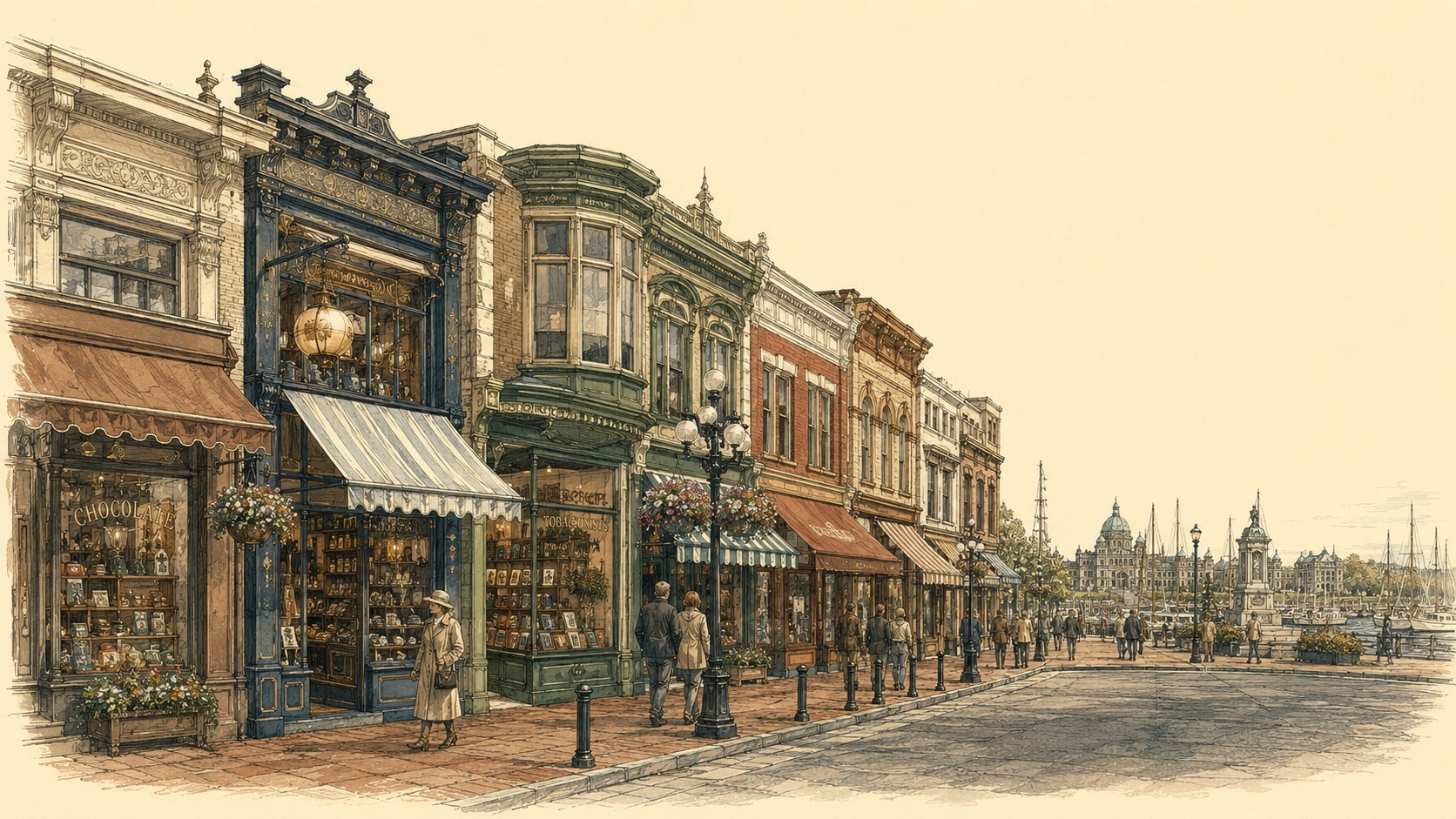
Victoria's independent business landscape runs from one-person operations to century-old storefronts. Downtown, some of the shops the city is known for are closing, one storefront at a time.
This guide follows sole proprietors, makers, and one-room shops rather than head offices. Their scale is both a strength and a weakness: the whole sector does not move as one, but every closure is somebody's whole livelihood.
The pressure shows downtown. Retail vacancy in the core roughly tripled, from low single digits before 2020 to a record near 11% in 2024, easing to 9.6% by late 2025 — but with nearly half of downtown businesses saying they'd consider closing if their lease came up within a year. A US-facing tech sector worth an estimated $7.9 billion no longer needs downtown floors. And yet, on one 200-metre stretch of Government Street, Canada's densest cluster of century-old shops still trades: Rogers' Chocolates since 1885, Murchie's since 1894, Munro's Books since 1963.
But that cluster is thinning in real time. Old Morris Tobacconist, open since 1892, closed in October 2025 after 133 years when its building sold. W&J Wilson, North America's oldest family-run clothier at 1862, left the downtown store in 2021. Irish Linen, founded in 1910 and a Government Street fixture for over a century, moved around the corner in 2024. This guide walks that street — who's still open, who's gone — and what it says about where the city's business is going. It's a living document: we update it as shops open and close, and when we get one wrong, we want to hear it.